Showing posts with label Greek. Show all posts

Saturday, 15 September 2007

Wine!


Do you drink wine?

Learn about it.

Just a little bit of everything you need to know about wine, how they taste it and how you can tell the wine you drink is good!

Myths and Truth

Don’t drink wine on an empty stomach. You get drunk fast!

---Did you know that olive oil helps? You don't get drunk that fast if you eat a nice salad with olive oil dressing.

---Take care! Too much wine causes dehydration.

The wine ‘over the counter’ is never as good as the bottled one.

---No one controls unbottled wine. There is no product name and no responsibility!

---Bottled wine is safer.

If you mix different kinds of wine you get drunk.

---Not true. It depends on the amount of the alcohol you drink. But if you mix different products such as wine (grapes) and vodka (potato), you get drunk.

TIPS

How to choose the right wine

When does a bottle of wine is not drinkable?

1. Examine the cork: problems at the cork result in a characteristic bad smell. That is not dangerous for your health though.

2. Acidosis: If air penetrates inside, the wine gets spoilt.

Some wines become better when they are left to mature in barrels or in their bottles. Most wines need 2 to 4 years to mature.

TASTING WINE

Get a glass of wine. Follow the 3 steps below:

Look at it.

Smell it.

Taste it.

Ask yourself:

  1. Is it clear enough to see through it?
  2. Is the aroma pleasant?
  3. Is the taste sweet, bitter or dry?

RETSINA

This Greek traditional wine, dates back to 3000 years, to Ancient Greeks!


This is a unique Greek product. To make it, they add to the white wine retina from pine trees.

WINE SELECTION

www.oinotrapeza.gr

South Greece

Petritis Chysohoou, Naousa

Simeonidis Wines

www.simeonidiswines.gr

Kavala-olive grove village

Email: simwines@otenet.gr

Friday, 27 July 2007

Some History


HISTORY IN BRIEF

Due to its important geographical position the island is the border between the East and the West. Mythology mentions Pheakes, the first inhabitants of Kerkyra whose hospitality to Ulysses when he shipwrecked on the island was made known through the works of Homer in Odyssey.

Mythology also mentions the myth of Kerkyra, one of the twelve daughters of Assop and his wife, Metopis. Poseidon, the god of the sea, fell in love with her, kidnapped her and brought her to this island to hide her from his wife, Amphitreti. However, Pluto, the god of Addis, envied Poseidon's success, and one night he kidnapped Kerkyra and took her down to Adis, leaving Poseidon their baby, Phaiakas. Therefore, in the years of Ulysses the island was named after him and was called the island of Phaeceans.

The island was also called by the Greek name of ‘drepanon’, because of its shape, and ‘Corfu’, because of the two peaks of mount Pantokrator.

In 734 the island was a Korinthian colony. Herodotus mentions that Kerkyra was at that time the best nautical force after Athens. The fact that Corfu possesses a vital strategic position was certainly a main cause for the island's occupation by various invaders such as Romans, Byzantines, Goths, Venetians, Sicilians and Catalans. Romans took over the island and then the Venetians in 1205.

. In 1537 the Ottomans attacked the island and the Venetian aristocrats ordered the residents to destroy their houses so as the Ottomans will not be able to take shelter and then settle down. It is said that over twenty thousand inhabitants were captured during the siege and then were sent to Istanbul. If the island did not have strong fortification it is certain that it would fall in the hands of the Ottomans who eventually surrendered and withdrew from the island. Later on, additional fortresses were built and the defense of the island was fortified.

Kerkyra remained under the reign of the Venetians until 1797. That year, Napoleon occupied Venice and the island was taken over by the French for the short period of one year. In 1799 the Ottomans occupied Corfu and next, after an agreement Turkey and Russia signed, the island was divided into sectors. That also lasted for a short time because, in 1815, the area was occupied by the British who kept the island until 1864, when they finally withdrew and handed it over to Greece. In 1824 the British built the Ionian Academy, which still exists. Till today, on the 21/05 every year, The Corfiots celebrate the anniversary of their freedom from the British by organizing church prayers, sport events and school parades. So, in 1864, Corfu joined Greece. But despite the fact that Corfu became Greek, the Italians never stopped desiring the possession of the island, so, in 1923 they bombed Corfu. In 1941 they occupied the island where they remained until 1943, when the Germans occupied it. The island was freed in 1944.

ARCHITECTURE

It is influenced by the west since the island was connected to the west for seven centuries.

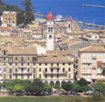
The Italian influence is shown at Liston area (Venetians 1205-1214)

(See Liston in the picture above).