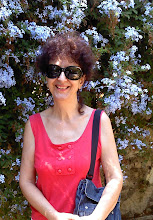
The painter Kostas Mikalef
presents his latest work this Saturday , 20th November, at
7.30 at the Public Theatre of Corfu.
The exhibition will remain open to the public till
the 4th December.
The painter Kostas Mikalef

Meet the animals, insects and plants living on the island.
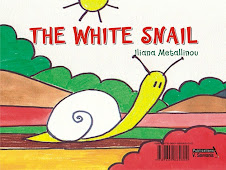
SNAILS
‘Hi,
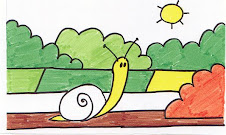
My name is Snail, but my Greek name is Saligari, or Bobolas in plain Corfiot language!
In my family we are in a variety of colors; the most common is brown with black stripes. White snails are quite common in fields with eatable plants such as lettuces, cabbages and broccoli (the green kind of cauliflower). I love the rain and I usually come out for a stroll after a nice heavy storm or a drizzle... I have to search for food, you see. That’s the time farmers really dislike me. Why? Read on to find out!
What do I eat?
Leaves; almost any kind of fresh green leaves will do. I am not too selective but I prefer those kinds human beings eat as they are the tastier. My worst time is when I go out to look for food because I am an easy prey. Birds catch me, you know, as I am part of the food chain. People eat me, too, but not very often since some of them think I am too slippery and creepy for their taste (I have to become more disgusting if I want to survive, but there are still those who find me cute; can you believe it? CUTE! How can a snail look cute?)
Well, I am an artifact too. My shell is a piece of art; people all over the world try to draw and paint my shell, so I am quite famous for my decorative designs. You can see lots of different shells at the
If you are online, you can learn more about my family here
http://www.geocities.com/sseagraves/allaboutsnails.htm
Now, would you like to read a story about me and my family?
Get the book titled The White Snail from a Corfiot bookshop or kiosk. Or visit my online address to order a signed copy at
http://toasprosaligari.blogspot.com’

The small
The Venetian culture
The Venetians cared for the olive oil production, so during their occupation
The Old Fortress
The Old Fortress is an excellent example of the fortification of the island that dates back to the Venetian times. This fortress has got a 60- meter bridge that links the castle to the square. Contra Fossa canal flows underneath and is currently used as a harbour for boats. At the entrance of the fortress there is the statue of Schulenburg who was a defender against the Turks. The fortress was first fortified by the Byzantines but the Venetians built complex tunnels and galleries to make it stronger. Inside the castle the visitor can see a prison building, the English Officers’ Quarters, the Barracks, the English Hospital and the chapel of Ayios Georgios, which is in Dorian style and was built by the English in 1840. From the top of the old fortress the traveler can see a panoramic view of
The New Fortress
The Venetians also built the New Fortress which is on the North West side of
The Esplanade
Another Venetian aspect that is still prevalent in Corfu town is the Esplanade (Spianada for the Corfiots) that is the heart of
More cultural influence
It is obvious that the Venetians influenced a lot the local architecture as well as all the other aspects of local life. Education was promoted and many institutions were set up, such as the music schools which are still running all over the island.


We have never seen this kind of fish here. The sea group of the protection of the environment club announced that they had spotted a new kind of fish species in the Corfiot sea. They stated that lately, the fishermen of northern
This kind of fish can be found in the sea of the isles on the north of Corfu (Othonoi, Erikousa, Mathraki) which is the meeting point of the Ionian sea and the
What exactly is this kind of fish?
Sphoeroides pachygaster is a fish of the Atlantic ocean that gradually came into the
How do these fish look like?
Sphoeroides pachygaster is short and fat with an inflated belly, smooth skin, big head that end to a ‘beak’ with jaws in four parts.
A few days ago a Sphoeroides pachygaster was caught in 80 m. depth by a Corfiot fisherman. It was 39 cm long.

The Music School of Corfu is located at
Who attends the 
Almost everyone interested in music! School kids mainly, since there are 19 brass bands today on the island and they need constant members. Young kids can start music lessons from an early age, usually from the third grade of Primary School. They are the most enthusiastic members since they look forward to parading with their band on celebration days!
Bands have also many adults who are experts on one or more musical instruments. During St. Spyridon processions many bands take part and this is a wonderful sight.
Musical heritage in
The


In Bosketo gardens, at the lower square of
At the celebration that took place in September, Lee Durrell, the wife of Gerald Durrell, thanked the authorities for the great honour, while the representative of
Sotiris Mikalef, the Mayor of the island mentioned the following:
“When the Durrell family settled down in
Durrell family has been one of our families since long ago, and I am happy I present today to the public the permanent presence of Durrell brothers on this island.”
The celebration ended with the National Hymns of Greece and England performed by Kapodistrias Band and a reception followed at the old Palace near the gardens.

Art exhibition in the old palace at the square.
At the Municipal Gallery in
The exhibition theme is divided into several parts.
The first part includes paintings dealing with the Interiors, where the visitor can see figures, fruit and the artist’s room, all in oil on canvas.
The second part has got Portraits in oil and tempera on paper. The third is about Nudes, displaying intriguing figures that show the passion of the artist for women. The fourth part is dedicated to Landscapes. Fantasy backgrounds and soft colors are the main features of his work.
Then comes the fifth part with The divided self figures, where the viewer will find themselves studying asylum figures in oil and tempera.
The sixth part includes Recent work in oil on canvas, such as
Giorgio Turchetti was born in
The exhibition will last till the end of August and visitors are given a booklet free of charge containing the art exhibits.


Corfu island On air!
Radio music is quite popular on the island. Walk into any shop in the town and you will listen to the songs or the commentary of a local radio station.
One of the most popular radio stations in
You can hear live music any time you are in and enjoy a variety of songs from a wide range of eras. The producer is Dimitris Savanis, a local young man who has a talent in picking up the right music from around the world. Life radio plays 24 hours a day and each music session, which usually lasts for 2 hours, is performed by a small panel of young men and women who select the songs and comment on a variety of aspects from around the world.
Last weekend a new music session started at 4 pm, directed by Bill Savanis and Tatiana Soulani. Bill is the owner and publisher of Aggelia-Online magazine and the site www.aggelia-online.gr, that promote businesses on the island and throughout
“If anyone wishes to sponsor our broadcast, they can contact me via www.aggelia-online.gr or contact Dimitri via www.liferadio.gr” Bill says. “Life Radio offers great promoting services for any business on the island”.
You can also join our group at http://www.facebook.com,
http://aggelia-online.blogspot.com
The
Start from the central square of Corfu called Esplanade, which is known as ‘the biggest square in the Valkans’, and Liston, which is the road with the arches that was designed and built by the Royal French after 1807 and is located on the west side of Esplanade, and you will get to St.Spyridon road. Go along St.Spyridon road starting from Liston and you will find yourself in the heart of the traditional area of the old town. At the end of the road there is a junction to Filarmoniki road, and just there is our shop which is located at the groundfloor of the building where Filarmoniki ‘Mantjaros’ is.
At the entrance of our shop which is at Filarmoniki road, you can find all the Greek products that are made from one of the most valuable product in the world, olive oil, which is a product of
Based on olive oil, plant-based cosmetics and pure traditional soap are produced in the old way they used to get produced years ago, as well as Greek sponges.
You can also find here Virgin Olive oil with acidity up to 0.3%, cold processed, straight from the Corfiot olive groves, as well as the best olive oil from all over
You can also buy black Kalamon olives, which are the best olives in the world, as well as thyme, oregano and all the spices of Mediterranean cooking.
Finally, here you can find all the Greek sweets and cakes and traditional Corfiot liquor, such as lemon liquor and Koum-kouat, ouzo and the best Corfiot wines.
At the entrance of our shop at
Handmade icons, old copper utensils that are at least 80 years old, lanterns in every shape, a selection of nargile items, handmade alabaster and original fossils.
Our business handles both retail and bulk orders.
We will be happy to meet you!
With respect,
Lygeri Kalogeresi

In recent years, many tourists who visit Kerkyra (Corfu for the non Greek) island end up in buying some kind of property on the area. Some of them become permanent residents, while others use their new home as a basis for their family holidays, once or twice a year. But why choose this kind of tourism? Nick, an Englishman, was one of the first to built a small cottage in Korakiana Village, on Kerkyra island. He first visited Kerkyra many years ago with his family, but it was much later when he found out that he could actually get a permanent place on the island he loved. “At first I thought that I would need a fortune to buy a decent house in a village,” he says. “But a friend of mine, who had already bought a ready cottage in Korakiana village, kept me informed bout the properties sold over there, and soon he spotted a bargain.” Nick has got a family of five, and they were all delighted at the prospect of a holiday house on Kerkyra. Nick was able to get a small stone house with a yard in front at a very low cost, and he built a two floored cottage in a year. “When I first saw it,” he admits, “it was a kind of ruined store room with nothing much to attract the buyer, but the scenery all around was fantastic, and that was the basic point. We would live in the nature, breathe fresh mountain air and see a wonderful view every day.” Nick filled the small yard with numerous flower pots with mountain herbs and flowers, and he made big windows to let the sun come into the cottage. “This will be our permanent house when we retire,” he adds. “Meanwhile, we visit Kerkyra 2-3 times a year and our kids come over in between their holidays too. We also let some close relatives to use it and some friends.” Nick is just one of the four other residents of the village neighborhood. A few meters further on, a couple from Holland have rebuilt their own house and visit it every summer. The neighbors keep an eye on it when they are away, and they even take care of their small vegetable garden. Some of the benefits of this kind of tourism, can be listed below: Save on rents of hotels, apartments etc. Save on meals of restaurants Carry no baggage Make new friends Ideal for retired people Ideal for relaxing in a natural environment Learn new lifestyle Try new food Some people object to this kind of tourism though. They think that the village will soon lose its identity as more foreigners than local people will be around in the future. This may be true, but the world is changing fast, more people migrate from their own countries and there will soon be an international mix everywhere. Who can stop the communication of cultures? No one can! |

Greek cuisine is renowned for its healthy ingredients such as olive oil, herbs and fresh vegetables. Olive oil is the top one healthy food that can get included in almost every single meal. Have you tried cakes made from olive oil? It’s worth giving it a try, even if you may not probably notice a great difference in taste-as I do! Olive oil is healthier than butter or margarine, so replace butter with olive oil and prepare your cake mix as usual. You will create a new version if you also add orange juice (or replace milk completely) and a drop of Greek brandy (Metaxa brand, 5 stars is the best). Less sugar than the usual recipe and add dark chocolate pieces or sultanas to enhance flavor. The result is fabulous! Fluffy and aromatic, this cake is the perfect dessert to satisfy your sweet tooth. Go olive oil then and stay healthy! The simple cake recipe: One bag of self raising flour Half a cup sugar 3-4 eggs One cup olive oil 1-2 vanilla essence portions 1-2 oranges (the juice) Some skimmed milk or a yoghurt 2% fat Half a cup of sultanas (optional) One bar of dark chocolate broken in small pieces Some brandy A pinch of salt How to make it: Mix olive oil with sugar and then add the eggs. Add the flour, milk or yoghurt (you can use both if you wish), Add the rest apart from the chocolate. Pour mixture into a tin and add the chocolate pieces one by one so as they are covered completely by the cake mixture. Bake at 150 C (you may need 180 in some ovens) for 3/4 of an hour or until golden. Enjoy it! |

Pistachio: A Greek bio product Did you know that pistachio grows on a Greek island? And that is the best quality of all other nuts since it is a bio product? Aegina island produces pistachio, the most popular nut in Greece (and the most expensive and tastier) that has got a special unique taste. It is also a bio product! Looking back to the 19th century, these special trees, pistachio trees, were not planted in Greece. Only in Aegina island this special tree finds the moisture it needs to grow. The soil is composed of clay, the substance clay pots are made of, so the water runs through it. The soil remains dry despite the amount of water found and that is the reason this nut is so delicious! What affects the taste of the nut? 1. It’s proximity to the sea. 2. The dry environment. 3. The small size of the trees. 4. The low level of humidity-even at night. 5. The composure of the soil. The crop is ready in August. They gather the nuts by spreading nets under the trees and shaking the branches with a stick. Then, a machine sorts out the nuts peels them and discards the bad ones. Next, the nuts are washed and are spread under the sun for 3-4 days to dry. Some farmers use a machine to dry them. When ready, they are put into bags and placed into the freezer for 3 days to kill the insects that may have remained alive. In there they can be preserved for up to 2 years. This bio product has no chemicals-just sea salt and real lemon juice on it! Where can you find pistachio in Corfu? Certainly in all big stores! Supermarkets have many varieties as well as coffee shops. Try Demetra markets or Sconto markets all over the island. For more information go to Aegina |