Showing posts with label culture. Show all posts

Monday, 13 December 2010

Art Display to help poor family...


EIKE (union of Corfiot painters)organizes an art display at the Municipal Art Gallery (old Palace)from the 15th December to the 24th December 2010 to raise money for a poor family.

Open hours: daily from 10 to 14-mornings only.
Low prices...

Saturday, 8 August 2009

Alikes Potamou

Alikes Potamou:

A popular bath resort for all the residents of Corfu that is located just a few kilometers off the town, opposite Evenos stores. There is a spacious parking lot and a well organized space filled with a number of facilities.


Those who wish to enjoy a swim along with a healthy dinner this is the ideal spot to do so! The taverna on the beach offers a variety of fresh fish like grilled sardines that are delicious! Meat eaters can have chicken chops (the specialty of the taverna) or beef steaks and/or the dish of the day which usually includes a freshly cooked casserole with seasonal ingredients. The taverna is open all day long and in the evenings too, all year round.

Prices are low-a lot lower than other places-and the quality of the food is exceptionally good. For example, the chips are made from freshly cut potatoes and the salads are being prepared on the spot. Kids can have ice cream or soft drinks and play at the garden electronic toys which are all around the taverna.


There is a small pool on the right and the tall eucalyptus trees that cast ample shade make the place cool and comfortable. There is no extra charge for the sun beds scattered all around the place or the sun umbrellas and benches. For those who wish to bring their own food and not sit at the taverna, there are many shady spots with wooden benches and tents on the left side of the taverna.


The beach is sandy and caters to kids and the elderly and all those who wish to have easy access to the sea. Some people may not like the shallow waters-the visitor has to walk a long way into the sea to be able to swim-but the sea is clean and warm and the view is marvelous. How can we testify the sea is clean? Well, there are tiny fish swimming and lots of live shells moving all around. This place gives the illusion you are in a far away place in Corfu, not so near to town. It only takes 5-10 minutes to reach the town centre, let alone enjoy so many facilities!

However, those who don’t want to enter this space they can still drive to the right side of the Baths, right to the bare beach, and have a swim on the other side of the area. This spot though has only two trees and a lot of sea weeds.


Enjoy your swim!

Sunday, 31 May 2009

Corfu and Venice: a cultural journey into the past


The small island of Corfu has always been considered a gem in Ionian Sea. The abundant green and its beautiful beaches used to attract people from all over the world, let alone its neighboring countries. So, Italian people could not underestimate Corfu’s beauty and strategic position, and claimed the island for the first time in the 12th century. The first Venetian occupation took place in 1205, and it was during that time that a lot of significant changes occurred on the island.

The Venetian culture

The Venetians cared for the olive oil production, so during their occupation Corfu olive groves started to expand. Nowadays the whole island is still covered with olive trees. The Venetian culture affected greatly the lifestyle of the Corfiots who were at that time privileged to live in a higher level cultural background, in contrast with the other Greeks on the mainland who were under the Ottoman occupation. The establishment of the Ionian Academy is an example of the cultural influence from the west. The Academy, which was destroyed in the years to come, has been fully rebuilt and houses now a part of the Ionian University.

The Old Fortress

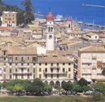
The Old Fortress is an excellent example of the fortification of the island that dates back to the Venetian times. This fortress has got a 60- meter bridge that links the castle to the square. Contra Fossa canal flows underneath and is currently used as a harbour for boats. At the entrance of the fortress there is the statue of Schulenburg who was a defender against the Turks. The fortress was first fortified by the Byzantines but the Venetians built complex tunnels and galleries to make it stronger. Inside the castle the visitor can see a prison building, the English Officers’ Quarters, the Barracks, the English Hospital and the chapel of Ayios Georgios, which is in Dorian style and was built by the English in 1840. From the top of the old fortress the traveler can see a panoramic view of Corfu town. The most picturesque part is that of the old town with the red tiled roofs and the traditional buildings.

The New Fortress

The Venetians also built the New Fortress which is on the North West side of Corfu town overlooking the old harbour. The two big gates of the New Fortress are still intact! On one gate visitors can see a winged lion. This is the Venetian emblem of Saint Marco. This fortress was completed in the 15th century.

The Esplanade

Another Venetian aspect that is still prevalent in Corfu town is the Esplanade (Spianada for the Corfiots) that is the heart of Corfu town. Spianada is next to the lower square of Corfu, and this area is the center for all local festivities and major social events. The top part of Spianada is at Liston place, which is called the small Paris, since it was built by the French during the French occupation of the island and its architecture is similar to the one found in Paris. The unique lamps at Liston were made by the Venetians and are an excellent sample of the art of that period.

More cultural influence

It is obvious that the Venetians influenced a lot the local architecture as well as all the other aspects of local life. Education was promoted and many institutions were set up, such as the music schools which are still running all over the island. Corfu has got 12 bands today! Celebrations and cultural events still include Italian aspects and the local language has been greatly affected too. The older generations still speak Italian and many modern residents still use some words that are of Italian origin. For example, the word ‘alibreto’ is used to describe the half closed window shutters. Time changes though, and I wonder if the new Corfiot generations will maintain that part of their tradition in the years to come!

Saturday, 18 April 2009

The epitaph...


The epitaph of St.Antonios church started at around 7.30 last evening. There was a crowd of people in the town but the spectacle was wonderful-as always.

School kids take part in the epitaph of each church as well as a band or two. In the photo above you can see a part of the marine corpse too.

Monday, 16 February 2009

The Music School of Corfu


The Music School of Corfu is located at Alexandras Avenue, a very beautiful area leading to Garitsa bay.

Who attends the Music School?

Almost everyone interested in music! School kids mainly, since there are 19 brass bands today on the island and they need constant members. Young kids can start music lessons from an early age, usually from the third grade of Primary School. They are the most enthusiastic members since they look forward to parading with their band on celebration days!

Bands have also many adults who are experts on one or more musical instruments. During St. Spyridon processions many bands take part and this is a wonderful sight.

Musical heritage in Corfu dates back to the Venetian occupation, hundreds of years ago, and it still remains as the main attraction of the Corfiot culture. “Philarmonikes”, the Greek name of the bands, add to the island a colourful character no other place in Greece possesses.

The Music School is the main spot for those who need to get educated in classical music. Passers-by can hear violin sounds quite often, or piano songs and opera parts if they are lucky enough! The whole block around this traditional building livens up to the daily sounds of music that are a familiar form of local culture.

Friday, 22 June 2007

Welcome to my place!

Hello everyone, and welcome to my blog!

I live on the beautiful island of Kerkyra (Corfu for the non Greek) which is next to Italy. Here's some information about the island, just to make sure you learn a bit about my place before we start our trip.

What is Kerkyra like?

Vast olive groves, tall palm trees along the sandy beaches, orange and lemon orchards amidst the groves, and mount Pantokrator on the north with scattered white-washed villages and tall church towers among the green, and the lingering in the air smell of wild herbs.

There you can admire ancient ruins and findings, numerous chapels and temples, museums and art displays for every taste; you can join local feasts and religious ceremonies, listen to band concerts, and watch international ballets and operas almost all year round.

Kerkyra is an exotic island with a European flavor, combining a taste of local and European culture. Several civilizations brought together, that is Kerkyra. You can see their mark everywhere, yet, you can feel that the island keeps its own unique flavor of local tradition.

The myth, the old and the new

The myth says that the people of Pheakes lived on the island during the years of Ulysses’travels. Their latest king Alkinoos with his queen, Ariti, had several sons and an only daughter called Nafsika. She was the one who found Ulysses on the shore one day and then the king helped him go back to his own kingdom, Ithaca. But god Poseidon , the god of the sea, was very angry with Ulysses and he turned his boat into stone, in order to punish him-that is what the local people say to justify the huge boat-like rock in Paleokastritsa bay.

Recent excavations in the town have revealed ancient sites that date back to the 5th century while there are ancient churches and other buildings all over the island.

Referring to modern history, the domination of the Venetians which lasted 410 years, of the French and of the British, left a definite mark on the aspect of contemporary Corfu. The island economy is based mainly on Tourism, as there are still unspoilt, beautiful landscapes and natural scenery all over the island.

Nowadays, the visitors can explore the whole Kerkyra and enjoy not only its natural beauty but also the numerous and unique sights the long tradition of the island has to offer.