Showing posts with label church. Show all posts

Saturday, 13 June 2009

Garitsa area, Corfu

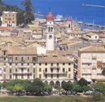
One of the most picturesque areas in Corfu town is Garitsa area. It is a green spot starting from Alexandras Avenue to Anemomylos place at the end of Garitsa bay.


The main church in this area is the church of Iasonos and Sosipatrou, which has old beautiful murals inside and a special architecture. It is certainly a sight worth seeing. Many ceremonies still take place at this church which is very popular among the residents.


The bay of Garitsa has always been the favorite promenade for the Corfiots who stroll along the seafront almost all the year round. Summer evenings are especially suitable for a stroll at Garitsa as the sea breeze is cooling and welcome. The tavernas along the inner side of the bay, in the green park, offer a restful and delicious evening out from spring to autumn.

Sunday, 19 April 2009

The epitaph of Ayia Triada


The epitaph of Ayia Triada church at Garitsa area started at 7.oo pm on Great Friday from the church and went around the block past The Douglas column and the Music School at Alexandras avenue into Alkinou street.

The majority of the epitaphs took place at Spianada, the center of the town where most churches are. Each church had its own epitaph, in and out of the town.

Saturday, 18 April 2009

The epitaph...


The epitaph of St.Antonios church started at around 7.30 last evening. There was a crowd of people in the town but the spectacle was wonderful-as always.

School kids take part in the epitaph of each church as well as a band or two. In the photo above you can see a part of the marine corpse too.

Saturday, 8 November 2008

Last Sunday's celebration


The procession of Saint Spyridon, the protector of Corfu, took place last Sunday morning in the town of Corfu.

Corfiots celebrated the miracle of the Saint that happened in 1673, when a plague epidemic hit the island. Then, Saint Spyridon sent the plague away and the Corfiots were saved.

An old local tale says that as the plague was leaving the island, she scratched with her nails the rock behind the old castle of the town. The signs are still visible to those who sail around the castle. You see, the plague was thought of as a monster who had iron nails and huge strength.

The procession was, as always, great and colorful. It was a sunny Sunday, as most days on this island are, and there was a crowd of people attending the ceremony.

Friday, 25 April 2008

Easter in Corfu


Happy Easter!

Enjoy the local Easter cookies and 'fogatsa' sweet bread flavored with mastic.

Where can you find them?
In all bakeries and super markets all over the island.

Easter in Corfu started last Sunday with the big procession of St.Spyridon. Today, each church will have their own mini procession (epitaphios), and the last one will take place after 10 pm. and will get through Liston area. Notice the color of the lantern lights along Liston. Tonight they will be violet, but tomorrow they will be white again.

Don't miss the first resurrection on Saturday morning at 11am. People use to throw pots from their windows as soon the bells start sounding. Then the bands walk along Liston and the Esplanade playing joyful parts. The second -and major- resurrection takes place at 12 midnight at the upper square of Corfu. Have a candle with you and watch the spectacle. Fireworks are shot and waves of lit candles move to all directions.

Happy Easter everybody!

Sunday, 23 December 2007

Merry Christmas!


A Christmas flower...

There's a whole Christmas flower tree below my balcony.


One day left for Christmas and Corfu is full of sunshine!
The weather forecast predicted rain but no, here it is spring time! But you never know! Tomorrow it may rain though there isn't a single cloud in the sky.

If you stroll along Garitsa bay and look at the horizon, you will see the mountain peaks of the Greek mainland and Albania covered in snow. That's why it is cold at night. But the sky is blue, the sea is blue and the birds are singing! That's why I love Corfu. It's a small paradise but some people still haven't realised that. They ruin things. Like those who broke into a small monastery on the 22nd of December and stole a couple of holy items such as the Bible (Evaggelio), which is 200 years old, the holy Cup and other church things.

The monastery of Ayios Noufris is administered by the villages of Ano Korakiana, Skripero, Gardelades and Doukades.

The villagers beg those who have taken these items to give them back.

Those who know something about this incident, to report it to the police.

The police are investigating this case and hopefully they will find the holy items.
It is the citizens' responsibility to care for their possessions and deeds like that should not be allowed in our community.


Sunday, 25 November 2007

Korakiana village


KORAKIANA VILLAGE

View from the yard of the church of Ayios Thanasis.


The village of Ano Korakiana, in the distance, looks like it is embraced by the mounts Korakio and Korendi that are located in the north-central Corfu and are 18 kilometers away from the town of Corfu.

The inhabited area of the village maintains a lot of traditional aspects from medieval times, and still shows resistance to the time and pressure of the modern lifestyle. However, the houses and the natural environment of a place are not the only aspects that define it. The people living in it are those who actually leave their indelible mark on it.

Today, the decrease in the village population is evident, despite the settlement, either temporary or permanent, of foreign families. As a result, a village that has got a dynamic presence, is within easy reach of Corfu town and other areas, is near the developed tourist resort of Dassia-Ipsos, starts getting affected by the modern trend of urbanization. The only hope that remains is the activation of some clubs and organizations such as the historic Music Association ‘SPIROS SAMARAS’, as well as the new generation of youths who choose to settle down here, thus going against the grain.

Since 1998, the areas of Ano Korakiana and Poulades (which is a few kilometers away) have been the public district of Ano Korakiana of Feakon Municipality.

Through history, Korakiana had the same fate as the rest of Corfu. However, at two historic moments of Corfu, Korakiana was severely damaged and its population decreased considerably. The first (and the worst) was in 1537, when the Turkish army of Highredin Barbarossa destroyed Korakiana. The second was in 1716 when he attacked the village for a second time.

The population of the village was renewed many times due to the settlement of people from other areas of Greece that were under foreign occupation (Aegean islands, Crete, Peloponissos).

A large part of the village population, right after 1204, came from the seaside towns of Small Asia and Thrace, while during the Venetian occupation, from the Aegean islands, Peloponissos and Epirus.

The oldest families still existing in Korakiana are those listed below:
Savvanis (since 1473), Vradis, Mandilas, Ionas, Markos, Metallinos, Laskaris, kaloudis, Linosporis, Reggis, Balatsinos, and finally, Kendarchos and Kefallonitis during the first half of the 16th century.

The village has got a considerable number of churches. There are 28 churches in the district of Ano Korakiana.

During the English ‘protectorate’ many local residents boomed in Corfu town working as owners (or workers) of bakeries, but generally, thrived in trade and are still keeping it up till now. This economic booming brought along spiritual and educational growth, thus many children started following careers in education or science all over Corfu, as well as in the rest of Greece after the union with the mainland.

Korakiana was also affected by this educational booming and the high educational level of its people is still prevalent in cultural and other types of celebrations of the village.

This is an image of the village after the Second World War, while its roots date many decades back, when the idea of illumination fertilized the village society.


[The above text is a translation of an extract located in the Greek site of Korakiana at
http://www.korakiana.gr/]