This month is ideal for some fresh air outings to the wonderful wildlife resorts of the island.
Last Sunday I visited Bioporos, an area on the south of Corfu, at Korission lake. The view was amazing, the eco farm was ecxellent as well as the fresh food they prepare for their visitors. This place is ideal for a vacation all the year round. Visitors can walk around the farm, walk up to the lake and then enjoy the meals at the farm restaurant. There is a lot to see, from local exhibits in the small museum, to wildlife species.
An interesting place to spend your time and relax!
Here's the link http://www.bioporos.gr
Showing posts with label nature. Show all posts
Showing posts with label nature. Show all posts
Wednesday, 16 February 2011

Monday, 13 July 2009
Go green

Corfu is a green paradise, but yet, working indoors can make you feel you are under pressure. But there is a way to alter this feeling wherever your office may be. Just read on!
Fourteen tips to an Eco-friendly office!
So, you are working in an office and feel you are destined to be confined in a cement environment for the rest of your life! But office life doesn’t mean you can not be in the eco spirit! There are several ways you can improve your working environment and then feel satisfied that you have finally contributed to a greener and healthier office life. It only takes a couple of steps and some determination.
Step one: Use your car less.
How can you do that? Arrange with a colleague to use your cars in turns or use public transport (which is the best solution as it causes less pollution).
Step two: Get plants.
Fill your office with plants. They not only enhance the atmosphere but also lessen the effects of radiation emitted from office equipment. Ask the florists about the best interior plants that need little care. Plants will also make you feel relaxed and happy.
Step three: Find the light.
Place your desk in the spot that is best lit. If there is a window, place your desk nearby as a source of natural light is always best.
Step four: Become paper aware.
If you use a printer, print on both sides of the paper. Waste less paper and contribute to less deforestation. Also, use recycled paper.
Step five: Ban felt pens.
Avoid using felt pens and use ball point pens instead. The latter contain less chemicals and do not smell.
Step six: Pins vs tape.
You can use pins or clips instead of adhesive tape which produces toxins and it is not bio-degradable.
Step seven: Save files.
Save your files on USB as CDs are disposable. In this way you produce less waste.
Step eight: Glass vs plastic.
You can use plates and glasses made of glass or china and avoid plastic altogether. Help the environment get rid of unnecessary waste that adds more pollution.
Step nine: Turn off your PC.
When you are not working, turn off your PC. Do not leave it on waiting mode. Save energy and lower your electricity bills.
Step ten: Lights off.
If you are the last to leave the office, don’t forget to turn the lights off.
Step eleven: Recycle.
Use the recycling bins near your office. Sort out the waste you produce during your office hours. Get in the recycling habit now!
Step twelve: Rest room changes.
If you run your own business, replace the faucets in the bathroom with taps having a photocell, and buy lamps that save energy. Also, install hand driers and do not waste paper.
Step thirteen: Charity aware.
Start a co-operation with WWF that has got special programs for businesses, at www.wwf.com
Step fourteen: Beware of snack packaging.
Avoid aluminum foil, plastic bags or one use dishes for your snacks. Choose a package that you can reuse. Why not get your own lunch box from home?
So, you see there are many ways to be eco friendly and enjoy a better office environment. It’s up to you to make some changes in your life and encourage others to follow you. Remember that this planet needs our co-operation to survive!
Friday, 3 July 2009
Water color display at Anemomylos

Yesterday I had the opportunity of visiting Anemomylos area in Corfu. Anemomylos took its name from the windmill that used to be there in old days. Nowadays, a reproduction of the original mill has been constructed that houses art exhibitions during the summer.
The current art exhibition of the well known Corfiot painter G. Zervos started on Wednesday 1st of July and was organized by the cultural and environmental group of the area. The water color exhibition will last till the 15th of July.
Opening hours:
10:00 to 12:00 in the morning
and
7:30 to 10:00 in the evening.
Mr Zervos has organized 60 exhibitions so far, both in Corfu and other places in Greece, and specializes in water color. However, he also paints in oil color and the visitors now can admire his unique color pallet in that medium too. All of his pictures depict well known Corfiot landscapes that are so characteristic.
His paintings show his apparent sensitivity in color and construction (he is a civil engineer)and the visitors will be fascinated by the variety of hues that he uses to depict Corfiot nature. The buildings he paints are in great detail and look like photographs. His price list is decent and caters to all art lovers.
If you love art and would like to get a painting to remind you of Corfu island, don't miss this exhibit
 ion!
ion!(Here is the view from Anemomylos)
Sunday, 7 June 2009
I Live in Corfu!

Meet the animals, insects and plants living on the island.
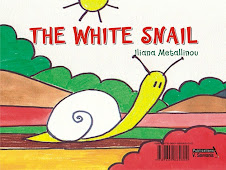
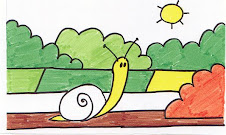
SNAILS
‘Hi,
My name is Snail, but my Greek name is Saligari, or Bobolas in plain Corfiot language!
In my family we are in a variety of colors; the most common is brown with black stripes. White snails are quite common in fields with eatable plants such as lettuces, cabbages and broccoli (the green kind of cauliflower). I love the rain and I usually come out for a stroll after a nice heavy storm or a drizzle... I have to search for food, you see. That’s the time farmers really dislike me. Why? Read on to find out!
What do I eat?
Leaves; almost any kind of fresh green leaves will do. I am not too selective but I prefer those kinds human beings eat as they are the tastier. My worst time is when I go out to look for food because I am an easy prey. Birds catch me, you know, as I am part of the food chain. People eat me, too, but not very often since some of them think I am too slippery and creepy for their taste (I have to become more disgusting if I want to survive, but there are still those who find me cute; can you believe it? CUTE! How can a snail look cute?)
Well, I am an artifact too. My shell is a piece of art; people all over the world try to draw and paint my shell, so I am quite famous for my decorative designs. You can see lots of different shells at the
If you are online, you can learn more about my family here
http://www.geocities.com/sseagraves/allaboutsnails.htm
Now, would you like to read a story about me and my family?
Get the book titled The White Snail from a Corfiot bookshop or kiosk. Or visit my online address to order a signed copy at
http://toasprosaligari.blogspot.com’
Sunday, 25 November 2007
Korakiana village
 |
KORAKIANA VILLAGE
View from the yard of the church of Ayios Thanasis.
The village of Ano Korakiana, in the distance, looks like it is embraced by the mounts Korakio and Korendi that are located in the north-central Corfu and are 18 kilometers away from the town of Corfu.
The inhabited area of the village maintains a lot of traditional aspects from medieval times, and still shows resistance to the time and pressure of the modern lifestyle. However, the houses and the natural environment of a place are not the only aspects that define it. The people living in it are those who actually leave their indelible mark on it.
Today, the decrease in the village population is evident, despite the settlement, either temporary or permanent, of foreign families. As a result, a village that has got a dynamic presence, is within easy reach of Corfu town and other areas, is near the developed tourist resort of Dassia-Ipsos, starts getting affected by the modern trend of urbanization. The only hope that remains is the activation of some clubs and organizations such as the historic Music Association ‘SPIROS SAMARAS’, as well as the new generation of youths who choose to settle down here, thus going against the grain.
Since 1998, the areas of Ano Korakiana and Poulades (which is a few kilometers away) have been the public district of Ano Korakiana of Feakon Municipality.
Through history, Korakiana had the same fate as the rest of Corfu. However, at two historic moments of Corfu, Korakiana was severely damaged and its population decreased considerably. The first (and the worst) was in 1537, when the Turkish army of Highredin Barbarossa destroyed Korakiana. The second was in 1716 when he attacked the village for a second time.
The population of the village was renewed many times due to the settlement of people from other areas of Greece that were under foreign occupation (Aegean islands, Crete, Peloponissos).
A large part of the village population, right after 1204, came from the seaside towns of Small Asia and Thrace, while during the Venetian occupation, from the Aegean islands, Peloponissos and Epirus.
The oldest families still existing in Korakiana are those listed below:
Savvanis (since 1473), Vradis, Mandilas, Ionas, Markos, Metallinos, Laskaris, kaloudis, Linosporis, Reggis, Balatsinos, and finally, Kendarchos and Kefallonitis during the first half of the 16th century.
The village has got a considerable number of churches. There are 28 churches in the district of Ano Korakiana.
During the English ‘protectorate’ many local residents boomed in Corfu town working as owners (or workers) of bakeries, but generally, thrived in trade and are still keeping it up till now. This economic booming brought along spiritual and educational growth, thus many children started following careers in education or science all over Corfu, as well as in the rest of Greece after the union with the mainland.
Korakiana was also affected by this educational booming and the high educational level of its people is still prevalent in cultural and other types of celebrations of the village.
This is an image of the village after the Second World War, while its roots date many decades back, when the idea of illumination fertilized the village society.
[The above text is a translation of an extract located in the Greek site of Korakiana at
http://www.korakiana.gr/]
Wednesday, 18 July 2007
Herbs: Corfiot Chamomile

Chamomile is found on Mount Pantokrator. The road you can see in the pictusre leads to the top of the mount. There you can find chamomile flowers in springtime and summer. To pick chamomile flowers collect only the flower top (anthos) not the stem. The best time to pick chamomile flowers is in the morning, before the sun goes up. Leave the fresh flowers to dry under the sun for a couple of days. Store them in a jar and use them like normal tea leaves.
|
Chamomile is a beautiful small flower that grows on Mount Pantoktrator, as well as in fields and gardens. I remember my mum picked the flowers up from our garden, dried them in the sun and used them to make chamomile tea.
It is good for colds, stomach upsets, indigestion, skin irritation and lots of other treatments. The best chamomile is the natural one, but you must know where to find it and make sure this place is not polluted. On the mount it is clean and fresh but not easy to get it!
Where to get chamomile:
In big supermarkets you can find chamomile bags or dried flowers. You can make chamomile tea the same way you make common tea.
Chamomile-how to use it
Sore throat and colds
In a cup of chamomile tea add a teaspoonful of honey and some lemon juice. Sip at intervals. This remedy provides you with ample vitamin C and rare honey properties that boost your immune system.
Stomach upsets
Prepare a cup of chamomile tea and add some lemon juice. Drink slightly warm or cold. For best results, drink it first thing in the morning on an empty stomach.
Insomnia
A cup of chamomile tea before bedtime is highly relaxing.
For external use:
Stiff neck
In a pan, simmer some dried chamomile leaves in pure olive oil for a few seconds. When still warm (not hot), apply mixture to affected area. Leave as long as possible and repeat 2-3 times daily.
Ear ache
Prepare as above and apply some chamomile mix (on some cotton wool) to the back of the ear.
Aching joints
Apply mixture prepared as above on joints and leave for as long as possible. Repeat several times (use a bandage to hold cotton wool on affected area).
Mouth ulcers
Prepare chamomile tea and use it for gargling or as a mouth wash after meals and especially before bedtime. However, if mouth ulcers persist visit a doctor.
Skin problems
Women’s rash
Use cold chamomile tea to clean the affected areas. It can be used many times a day as it is soothing and healing.
Pimples
Cold chamomile tea is soothing and helps restoring the skin’s texture.
Bibliography
Ody, P. (1997) ‘100 Great Natural Remedies: using healing plants at home’ London, UK, Kyle Cathie Limited.
Related Sites
www.Englishteastore.com/camomile.html
http://greekfood.about.com/
Subscribe to:
Posts (Atom)