Sunday, 31 May 2009

Corfu and Venice: a cultural journey into the past


The small island of Corfu has always been considered a gem in Ionian Sea. The abundant green and its beautiful beaches used to attract people from all over the world, let alone its neighboring countries. So, Italian people could not underestimate Corfu’s beauty and strategic position, and claimed the island for the first time in the 12th century. The first Venetian occupation took place in 1205, and it was during that time that a lot of significant changes occurred on the island.

The Venetian culture

The Venetians cared for the olive oil production, so during their occupation Corfu olive groves started to expand. Nowadays the whole island is still covered with olive trees. The Venetian culture affected greatly the lifestyle of the Corfiots who were at that time privileged to live in a higher level cultural background, in contrast with the other Greeks on the mainland who were under the Ottoman occupation. The establishment of the Ionian Academy is an example of the cultural influence from the west. The Academy, which was destroyed in the years to come, has been fully rebuilt and houses now a part of the Ionian University.

The Old Fortress

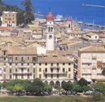
The Old Fortress is an excellent example of the fortification of the island that dates back to the Venetian times. This fortress has got a 60- meter bridge that links the castle to the square. Contra Fossa canal flows underneath and is currently used as a harbour for boats. At the entrance of the fortress there is the statue of Schulenburg who was a defender against the Turks. The fortress was first fortified by the Byzantines but the Venetians built complex tunnels and galleries to make it stronger. Inside the castle the visitor can see a prison building, the English Officers’ Quarters, the Barracks, the English Hospital and the chapel of Ayios Georgios, which is in Dorian style and was built by the English in 1840. From the top of the old fortress the traveler can see a panoramic view of Corfu town. The most picturesque part is that of the old town with the red tiled roofs and the traditional buildings.

The New Fortress

The Venetians also built the New Fortress which is on the North West side of Corfu town overlooking the old harbour. The two big gates of the New Fortress are still intact! On one gate visitors can see a winged lion. This is the Venetian emblem of Saint Marco. This fortress was completed in the 15th century.

The Esplanade

Another Venetian aspect that is still prevalent in Corfu town is the Esplanade (Spianada for the Corfiots) that is the heart of Corfu town. Spianada is next to the lower square of Corfu, and this area is the center for all local festivities and major social events. The top part of Spianada is at Liston place, which is called the small Paris, since it was built by the French during the French occupation of the island and its architecture is similar to the one found in Paris. The unique lamps at Liston were made by the Venetians and are an excellent sample of the art of that period.

More cultural influence

It is obvious that the Venetians influenced a lot the local architecture as well as all the other aspects of local life. Education was promoted and many institutions were set up, such as the music schools which are still running all over the island. Corfu has got 12 bands today! Celebrations and cultural events still include Italian aspects and the local language has been greatly affected too. The older generations still speak Italian and many modern residents still use some words that are of Italian origin. For example, the word ‘alibreto’ is used to describe the half closed window shutters. Time changes though, and I wonder if the new Corfiot generations will maintain that part of their tradition in the years to come!

Tuesday, 12 May 2009

Meet Vasilis Sgouros


Interview with Vasilis Sgouros, the owner of PhysioPraxis center in Corfu

Vasilis Sgouros has been working in this field for over 30 years.


Q: Welcome to our page Mr.Sgouros. We are delighted to have you here today. Fist of all, we would like to know about PhysioPraxis. What exactly is this center?

A: This is a center of Physiotherapy and Recovery

Q: What does this center include? What kinds of programs are available and who do they cater to?

A: The center includes the following programs:

Athletic Recovery
Exercise and Diet
Exercise and right posture for children and adults
Exercise special for facing chronic problems such as osteoporosis, arthritis and other
Ergonomics

These programs cater to almost everybody, young and old.

Q: Tell us about the first program, Athletic Recovery. What is it about and who is it aimed at?

A: Athletic Recovery is for those who do sports. Many times specific problems arise, so there is need for physiotherapy. Of course, each case is different and depends on various factors. The program we offer suits the individual’s specific needs.

Q: How about the second program, Exercise and Diet. Can you tell us a few things about that?

A: In co operation with a doctor who teaches metabolism in the University of Athens, I teach the right diet and exercise which is individualized. There is a personal trainer for each patient so as to get the most of this program.

Q: The next program is Exercise and right posture for children and adults. Whatexactly is that?

A: This one caters to those who have a problem with their body such as a dysplasia of the spine, foot problems such as platypodia etc. We offer special exercises to help both kids and adults.

Q: What can you tell us about the Exercise program for facing chronic problems?

A: This program is for those who have a chronic problem of their muscle and skeleton system. People suffering from osteoporosis and arthritis will find this program highly beneficial.

Q: The last one is Ergonomics. What is that?

A: Ergonomics is the relationship of our body with any special physical activity, such as housework, our job, using computers, watching TV, using the car, gardening and anything else we do every day. We give advice to ensure the right use of our body in relation with its activity. This means you will learn how to use your body, when you do your work the right way and so on.

It is important for the people to know this so as to get tired less and achieve more; Also they can get more energy and cause less damage to their muscles and skeleton system.


Q: Where is this center located? How can we contact you?

A: It is at Vraila Armeni 6, Tennis area. Our telephone is 26610 25637
Our email is Sgurosb@otenet.gr

Thank you for being with us!


Monday, 4 May 2009

A Banana Tree in a Corfiot garden!

I have walked past that garden so many times, for so many years and have never noticed that plant! Funny, isn’t it?

I was born in that old house and played in that small garden, but I have always thought that plant was a palm tree. It was smaller at that time anyway, and I was a kid-kids hardly notice these things. I was more concerned about my cats and chicken and less about the banana tree. But yesterday, as I was walking past that spot once more, I saw it. I didn’t have my web camera with me so I had to come back later to take a shot.

The first glimpse of that huge lamp- like flower deceived me; I thought-what is that, looks like a plastic lamp. You see it was hanging gracefully over the gate just in the middle of it. Exactly as a lamp should hang! Then I noticed a thick cord upwards that looked like a twisted wire. Looking up I saw the bananas; small green bananas facing the sky. You can see the pictures above. I had never seen a banana tree in blossom before. It is certainly a spectacle!

I searched the net and found these links. Just in case you would like to plant a banana tree in your garden!

http://www.banana-tree.com/Banana_Tip.cfm

http://en.wikipedia.org/wiki/Banana


Sunday, 26 April 2009

Menecrates’ tomb


Who was Menecrates?

He was a famous Greek sculptor who lived in Corfu during the 7th century BC. One of the ancient sights you can visit on the island is his tomb-a cenotaph- which is right in the town.

The tomb should be restored and properly conserved but as it always happens here, it is abandoned along with the site next to it. Since the whole place has historical value-well, almost all the sites on the island have-the town council should do something about that. But I think they have run out of funds once more!

Menecrates' tomb which dates back to the 7th century BC is depicted here:

http://www.mlahanas.de/Greece/Cities/Corfu1892_03.html

The lion of Menecrates was found in Corfu near the tomb of Menecrates at Alkinou street in the town. See the lion here:

http://www.travel-to-corfu.com/photo.php?photo_id=64

Learn more about Corfu and the sights you can visit, here:

http://www.kapatel.gr/tourism/corfu/index6.htm


Sunday, 19 April 2009

The epitaph of Ayia Triada


The epitaph of Ayia Triada church at Garitsa area started at 7.oo pm on Great Friday from the church and went around the block past The Douglas column and the Music School at Alexandras avenue into Alkinou street.

The majority of the epitaphs took place at Spianada, the center of the town where most churches are. Each church had its own epitaph, in and out of the town.

Saturday, 18 April 2009

The epitaph...


The epitaph of St.Antonios church started at around 7.30 last evening. There was a crowd of people in the town but the spectacle was wonderful-as always.

School kids take part in the epitaph of each church as well as a band or two. In the photo above you can see a part of the marine corpse too.

Sunday, 12 April 2009

Easter holidays in Corfu


Today, Sunday the 12th April, the Greek Easter holidays have started. Schools closed last Friday, but all shops will remain open till next Saturday, when Corfiots celebrate Easter at the square of the island.

What will you buy this week?

First of all, FOGATSA, the special sweet bread that is the traditional treat for the whole family. Fogatsa can be eaten any time, at breakfast or as a snack during the day. In case you buy too many fogatses and they have become dry, you can slice them and grill them-eat them like a toast with honey or jam. Despite the fact that some bakeries sell fogatsa all the year round since it is very popular, now it is the time to get one, in a variety of shapes. Round ones are softer, small one-serving ones are best for the kids. Get fresh fogatses from bakeries (at a lower price) and from confectionery shops and supermarkets. Most of them are mastic flavored but the real corfiot fogatsa has orange flavor.

What else?

An Easter candle. They sell white and colorful candles for kids and adults all over the town. Kids usually get candles with small toys attached on them-this is the manufacturers' lure to attract more customers. Traditional candles are while with ribbons or wax colored natural candles. If you don't have time to buy candles now, pop into a supermarket and get some plain ones or wait till Saturday when you can get candles on the way to the square; there will be many stalls selling candles to those who like to get them the last minute!

What about Easter food supplies?

Tradition says you have lamb or goat meat in your fridge, to get it ready for Easter day.
If you don't have a spit to roast it, use your oven. Whatever you do, add a lot of lemon and oregano and let the flavor torture you till it gets ready! Olive oil is a must as well as ample salad.
Lettuce and cucumber along with fresh onions and tomatoes are ideal for a fresh salad to accompany the meat. Some people boil legumes or make vegetable pies-any will do. Some local -or bottled-red wine will complete the meal. Don't miss the olives and feta cheese on the Easter table! And the red eggs of course! Buy more than a dozen as eggs are tricky! They crack so easily during boiling that you may need a lot more!

What about home decoration?

Apart from baskets with red eggs-or colorful eggs- that you can put on many spots of your house, get flowers. Spring time is here and one or more vases with flowers will lighten up the atmosphere. Or you can get some flower pots from your balcony. The most enjoyable thing for me is to paint egg faces on hard boiled eggs! It's so easy to do, just take care to have a couple hard-boiled eggs(leave them to boil for at least 10 minutes).

Here is how to do it once the eggs are ready and cold.


Cut out rings from the kitchen paper hard card roller (the inside) to use as base.

Stick glossy paper on the rings or paint them with tempera or acrylic.


Place an egg on each ring and draw a face on it. You can use a pencil and fill in the design with
tempera or acrylic color.


You can either draw some hair or make a cap/hat or handkerchief to cover the top of the head.


Be creative! This is fun for the kids and all the family and a great gift for relatives and friends!

Happy Easter!